Every time a tech company announces layoffs, the same headline appears: "AI takes jobs." It is a clean narrative. It is also wrong in most cases.
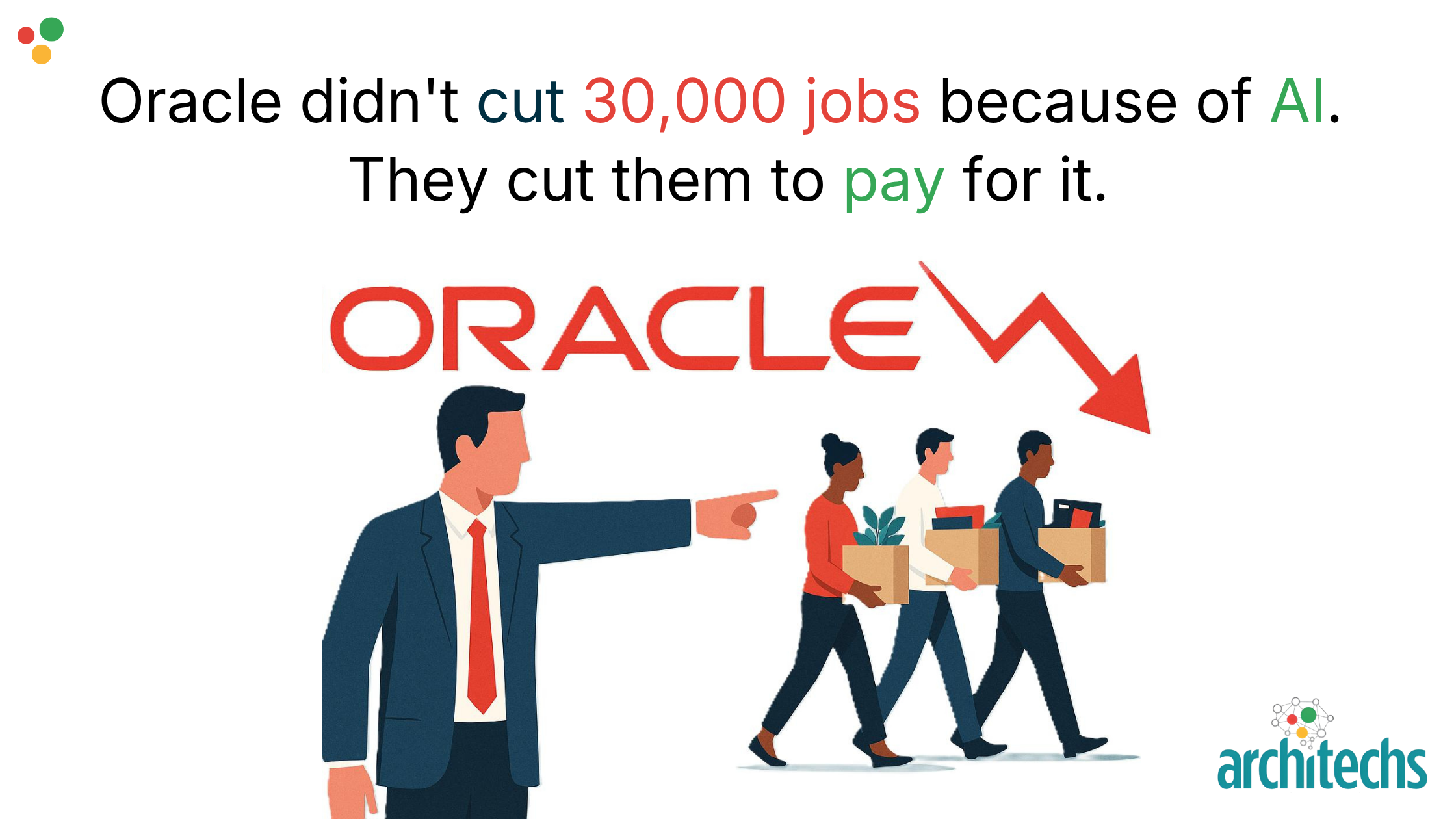
On March 31, Oracle eliminated up to 30,000 employees in what analysts are calling the largest layoff in the company's 48-year history. Employees across the US, India, Canada and Mexico received termination emails at 6am. No call from HR. No conversation with a manager. System access cut within minutes.
The headlines blamed AI. The numbers tell a different story.
Oracle posted $17.2 billion in quarterly revenue, up 22%. Net income surged 95% to $6.13 billion. Remaining performance obligations hit $553 billion. This is not a company in decline. This is a company whose AI infrastructure ambitions outpaced what its balance sheet could support while keeping 162,000 people on the payroll.
The layoffs free up $8 to $10 billion in annual cash flow according to TD Cowen. That money goes to GPU clusters and data centres. Not to AI systems that replaced the people who just got fired.
The roles being cut prove the point
The hardest-hit divisions were Revenue and Health Sciences, SaaS Operations, and NetSuite's India Development Centre. Each lost approximately 30% of staff. Engineers, architects, database administrators, ERP implementation specialists. These are not roles that AI can perform today. They are the people who built Oracle's enterprise business over decades.
They were not made redundant by technology. They were made redundant by a spreadsheet.
Oracle is spending $50 billion on cloud infrastructure this year while simultaneously firing the cloud engineers who build and maintain it. The company took on $58 billion in new debt in two months, its free cash flow turned negative $10 billion last quarter, and multiple US banks have reportedly stepped back from financing some of its data centre projects. The irony is not subtle.
This is an industry pattern, not an Oracle anomaly
Microsoft cut 15,000 employees while ramping data centre spending. Amazon has cut 30,000 since October 2025. Block cut 40% of its staff. In each case, corporate payrolls are being trimmed to fund AI infrastructure investment. Not because AI replaced the people doing the work.
Sam Altman himself has called this "AI washing," where companies use AI as cover for cost restructuring that has nothing to do with automation. An Oxford Economics study found limited evidence that AI is replacing workers at scale. The jobs are disappearing into capital budgets. Not into algorithms.
The execution tells you everything about the motive
If Oracle had genuinely identified roles that AI could perform, you would expect phased transitions. Reskilling investment. Role-by-role assessment. Communication from managers.
Instead: a mass email at 6am. Immediate system lockout. No manager communication. Unvested RSUs forfeited on the spot. A $2.1 billion restructuring charge filed with the SEC, with $982 million already recorded in the first nine months of fiscal 2026, primarily for severance.
That is not a considered transformation. That is financial engineering executed at speed. The method reveals the motive.
Why this matters for your AI strategy?
Enterprise leaders are watching Oracle and asking whether they should be doing the same. Cutting headcount, labelling it AI transformation, moving on. Some boards are already asking the question.
The answer should concern them.
We work with organisations across financial services, government, health and utilities on AI strategy and enterprise architecture. The pattern we see consistently is this: the companies doing AI well are not mass-firing people. They are redesigning operating models, reskilling teams, and deploying AI where it creates genuine leverage. They are also honest about what AI can and cannot do today.
If your AI strategy starts with a headcount target, you do not have an AI strategy. You have a cost-cutting exercise with a technology label on it.
The executives who get this right start with the operating model. Where does AI create value? Where does it create risk? What changes in how work flows through the organisation? Headcount decisions follow those answers. They do not precede them.
What Oracle did is not an AI strategy. It is a capital reallocation that happens to involve AI infrastructure. The distinction is critical for any organisation that wants AI to create lasting value rather than a short-term cash flow bump.
The Oracle story is about a company borrowing $58 billion to build data centres and needing to cut $10 billion from its payroll to service that debt. The AI label is convenient. It is also misleading.
For enterprise leaders watching this unfold: do not let the noise distract you. AI transformation is real. But it looks nothing like what happened at Oracle on March 31.
If you are navigating AI strategy in your organisation and want a practitioner perspective on where AI creates genuine value versus where it is just a label, let's have a conversation.
Sources: CNBC, Bloomberg, TD Cowen, Oxford Economics, SEC filings (Oracle 10-Q March 2026)
.svg)


.png)