Related Blogs
April 4, 2026
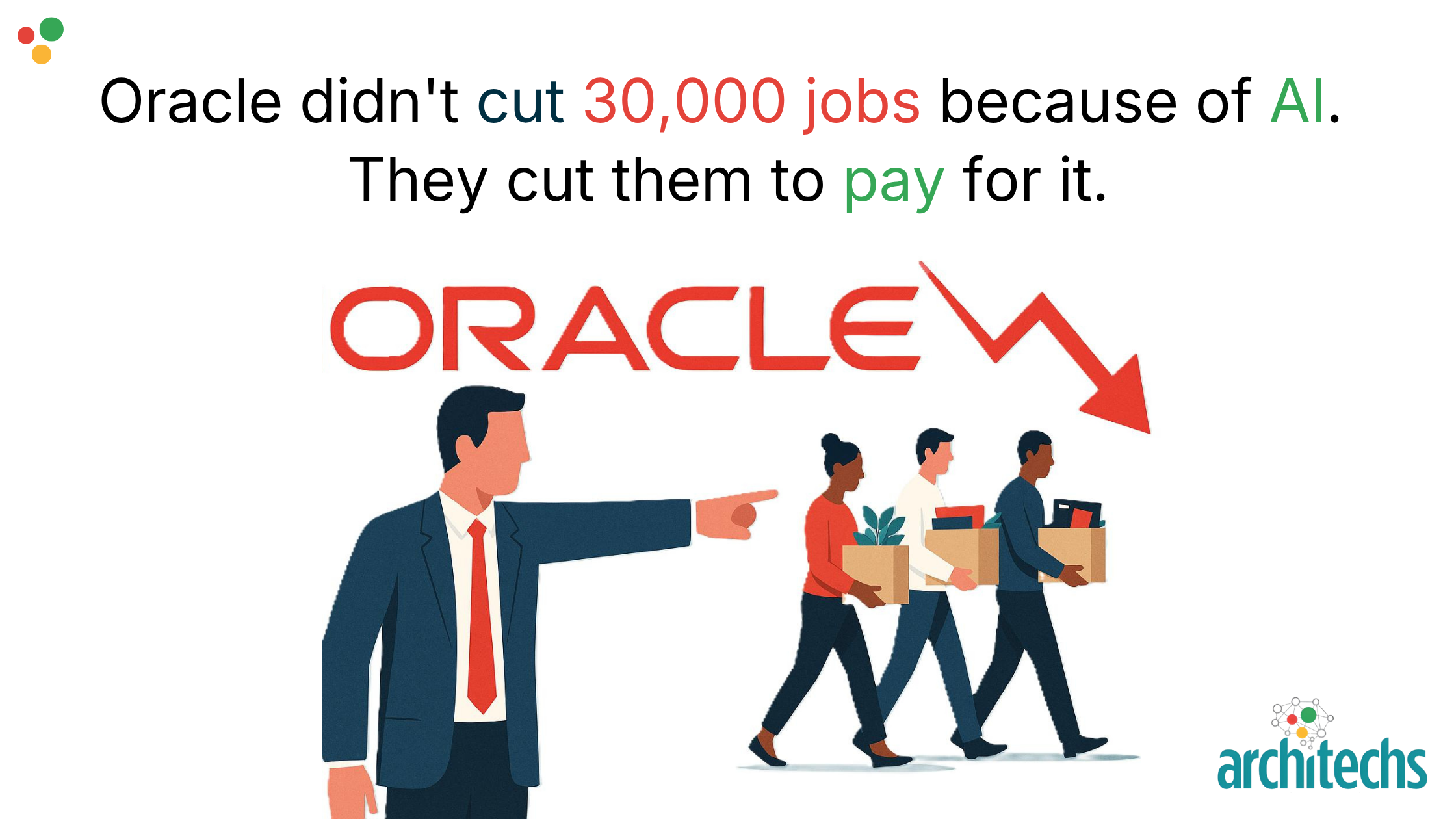
Oracle didn't cut 30,000 jobs because of AI. They cut them to pay for it.
.
Oracle just cut 30,000 people. The headlines say AI did it. The balance sheet tells a very different story.
Read More
.svg)



Every board I sit in front of wants to talk about AI strategy. Almost none want to talk about what it will cost the people running the business. That is where AI programs actually fail.
The technology is no longer the hard part. Foundation models are commoditising. Platforms are maturing. Implementation patterns are known. What has not changed is the organisation receiving the change.
AI does not get deployed into a vacuum. It gets deployed into an operating model designed for a different era, run by people whose status, budget, and authority were built inside that model. The strategy that ignores this ships a deck and nothing else.
Most enterprise operating models were engineered for information scarcity and sequential work. AI collapses both. When a capability that reallocates decisions, accelerates cycles, and redistributes information lands inside structures built for the opposite, friction is guaranteed.
Jay Galbraith’s Star Model made this plain decades ago. Strategy, structure, processes, rewards, and people must reinforce each other. Change one without the others and the system snaps back. MostAI programs change strategy and nothing else. The program is then asked to deliver a new outcome through an old machine and scored on why it did not.
French and Raven’s five bases of power, published in 1959, remain the most useful lens on why senior leaders block things that make obvious sense. Legitimate, reward, coercive, expert, and referent. AI threatens two directly.
Expert power erodes when judgement that used to require years of tenure can be compressed into a well-designed workflow. Legitimate power erodes when decision rights rooted in hierarchy get routed around by evidence the hierarchy did not produce. Executives feel this before they can articulate it. Resistance then shows up in the language of risk, governance, and prudence, which is harder to argue with than the real objection underneath.
The inverse failure is equally damaging. Expert power gets claimed by people who have not earned it.A business leader who has attended three vendor keynotes can walk into an ExCo with more confidence on platform architecture than the CTO who has delivered four of them. Referent power, charisma and conviction, fills the gap where expertise should sit. The room cannot always tell the difference in the moment.
Jeffrey Pfeffer’s point, sharpened over thirty years, still lands. Organisations are political. Pretending otherwise just makes you the person who did not see it coming.
Executives sponsor AI. Teams execute AI. Middle management decides whether AI reaches production. Their authority depends on coordinating information between levels. AI collapses the coordination cost that justifies their scope. The incentive to slow, reshape, or starve the program is structural, not malicious. It shows up as budget fights, scope arguments, talent hoarding, and “let’s pilot first” as a permanent condition rather than a phase.
John Kotter’s 1995 HBR essay on why transformations fail identified the pattern and it has not aged.
Programs die when the people whose cooperation is required are not measured on whether the program succeeds. Worse, the people whose preferences carry the day are often not measured on the consequences of their preference at all.
If a business function with no operational accountability for the platform gets a controlling voice in selecting it, they will optimise for what looks good in the room, not what runs in production. The incentive system is the thing that is broken, not the people inside it.
Something has shifted in the last three years. Business functions are making architectural decisions they are not equipped to make, and governance models inside most enterprises have not caught up.Vendor marketing has industrialised the process. An executive attends a keynote, sees a customer panel, and returns with conviction that a specific product is the answer. Conviction does not need technical grounding to be persuasive in an ExCo.
This is not a call to hand architectural decisions back to IT. It is a call to name who bears the cost of a decision and ensure they carry proportional weight in making it. The firm that lets its loudest function win its most consequential decisions ends up with an architecture nobody can run.
A recent engagement at a large Australian FSI. The brief was a Data & AI platform strategy and selection. Business case built. Requirements workshopped across every domain. Technical evaluation scored against a weighted matrix.
Option A was a single integrated capability covering data warehouse, data lakehouse, DSML, GenAI, and agentic workloads under one governance model. Already the firm’s global corporate standard.Already licensed. Already deployed in key Worldwide regions.
Option B was multiple best-of-breed products stitched together to cover the same surface area. Three times the total cost of ownership. More integration glue. Fragmented governance across several vendor contracts, security models, and operational run books. Option A won on every dimension that mattered. The selection stalled for months anyway.
The derailment came from the business, not IT. A vocal coalition inside the business functions had returned from the vendor conference circuit with strong conviction around Option B. They were making deep technical and architectural decisions from keynote slides and customer panels. The loudest voices had never run a platform in production. None would carry the integration burden, the operational load, or the governance complexity their preferred option would create. The cost would land on teams not represented in the room.
Underneath sat a more honest question nobody wanted to put on a slide. Who owns the platform.The CDO saw it as a data asset. The CTO saw it as infrastructure. Enterprise Architecture saw it as a reference architecture decision that belonged to them. Each function had a defensible claim. None would cede it. The platform debate became a proxy for an ownership contest that had been deferred for years.
Then the second fracture opened. The AI agenda was loud, visible, and career-defining. The data foundation work was quiet, unglamorous, and two years of pipeline re-platforming before anyone could ship a credible AI product. Option A forced the firm to confront the foundation gap honestly.Option B let them look busy on AI while the data substrate stayed broken. Political gravity pulled toward Option B for reasons no business case would ever capture.
What unblocked it was not another evaluation cycle. It was an ExCo-level decision on ownership, written down and signed, before the platform question was reopened. Decision rights first. Technology second. The reverse sequence had been the source of the deadlock.
Every platform debacle I have seen follows the same pattern. The technically superior option loses to the one whose sponsor won a political contest nobody admitted was happening.
Write a second document nobody asks for. List every executive who loses scope, budget, head count, or influence if the strategy succeeds. Next to each name, write what they get in return. Then list every executive whose preference will shape the decision and note whether they will carry any consequence of that preference being wrong. If either list does not hold up, it is not a strategy. It is a press release.
The firms that will pull ahead in the next cycle are not the ones with the best models. They are the ones willing to redesign the operating model before the model arrives.







.png)